

- Advertisement -
- Advertisement -
Quick answer: South Indian food has surged across urban India — dosa, idli, vada and filter coffee have moved from regional comfort food to mainstream vegetarian staples in cities like Delhi, Gurugram and Bengaluru, driven by health-conscious diners and a wave of quick, affordable South Indian outlets.
Walk into any food court in Delhi and Gurugram on a Tuesday afternoon, and see how many dosa stalls you can find. They are always two or three at most. But the lines at these are much longer than the line outside the burger stall next door.Clearly, something has changed. South Indian cuisine, which was regarded as comfort food in North India for people from Tamil Nadu, Karnataka, Andhra Pradesh, and Kerala, has now taken root in India’s cities as a vegetarian staple.It started with breakfast
Idlis and dosas were convenient, filling, easy on the tummy, and inexpensive qualities, which made them a hit with the busy metropolitan population of Delhi and Mumbai.But the Indians in the cities didn’t stop there. They started asking for rava dosas, Mysore masala dosas, pesarattus, uttapams, and even Medu vada and sambar. Even the vocabulary grew.Those who ate chole bhature during the weekend were asking for filter coffee during weekdays.Why urban India specifically
Here are 3 factors influencing this trend in cities that don’t influence towns in the same way.Health awareness South Indian cuisine is fundamentally a health-conscious cuisine. Fermentation of batters, steaming of dishes, combination of rice and lentils to provide a balanced protein intake. The moment that millennials became aware of gut health and fermentation, idlis suddenly became a very intelligent food. Dosa batter that undergoes overnight fermentation provides natural probiotics. No marketer told this to anyone. This was discovered.Vegetarianism is an active choice India’s cities are witnessing their second wave of vegetarianism, independent of any religion-based vegetarianism. Youngsters consciously cut down their meat intake due to a lack of alternative protein-rich sources. South Indian food provides everything without making efforts.The trust in purity North Indian vegetarian restaurant culture has always existed. But South Indian food has a particular reputation for being oil-light, ingredient-simple, and preservative-free when done well. That perception matters in cities where “what’s actually in the food” has become a real concern.From niche to mainstream
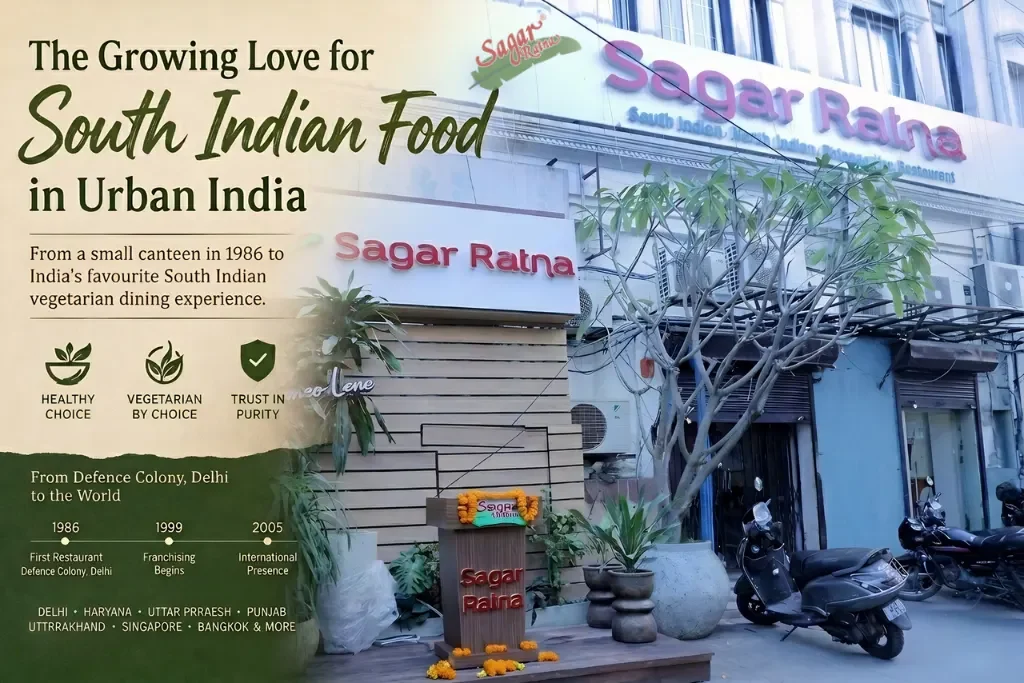
In Delhi, 20 years ago, South Indian cuisine could be found at 1 or 2 outlets in each area, often hidden away and having a slightly institutional feel. It was good food, no frills, but with limited seating.There is one chain that saw this change coming and established itself as a tiny canteen back in 1980, opened its first proper sit-down restaurant in Defence Colony, New Delhi, in 1986, and developed a unique business model based on just one thing: chutneys freshly made multiple times throughout the day, no preservatives used, and no shortcuts taken.From its first restaurant in Defence Colony to becoming the go-to best South Indian restaurant in Civil Lines and beyond, the expansion followed real demand.The chain had been franchised by 1999 and by 2005 had opened its doors in Singapore.What “authentic” actually means here
The word gets used loosely. But for South Indian food, it has a specific texture.The taste of sambar must be sour, not sweet. Chutney should be made fresh, not from a can. The dosa needs to be slightly crispy on the outside and soft on the inside. Filter coffee must be poured into a steel tumbler along with dabarah, and needs to be very strong to withstand milk.When these details slip, regular customers notice immediately. South Indian food has a loyal following precisely because the baseline is so established. People who grew up eating it in Chennai or Bengaluru carry the reference point with them everywhere. Restaurants that meet it earn repeat business. Those who don’t get found out quickly.The best South Indian restaurant question
Finding a decent South Indian place in an Indian metro isn’t hard. Finding the best South Indian restaurant in your city, one that takes the food seriously rather than treating it as what’s left after you remove the meat, is a different exercise.South Indian cuisine is inherently vegetarian-first. The cuisine wasn’t designed around meat and then adapted. It was built from grains, lentils, vegetables, and dairy. That structural difference shows in the result. The food has depth and complexity without needing substitution tricks.This is one reason South Indian vegetarian restaurants have been more successful in urban markets than many other vegetarian formats. The food doesn’t feel like it’s missing anything.The franchise signal
When the concept of a restaurant becomes scalable through franchising, then what it implies is that the food is standardised and the demand is consistent enough.The success story of Sagar Ratna franchising in the form of vegetarian restaurants, which started off in Ludhiana in 1999 and currently operates in Delhi, Haryana, UP, Punjab, Uttarakhand, and even outside India in Singapore and Bangkok, shows how true it is. It has more than 175 franchises, surpassing 5 crores of annual customers. The franchisees do not make investments on uncertain grounds.That they operate in all types of places, including food courts (DLF Promenade, Ambience Mall, Cyber Hub), individual restaurants, hospitals (Fortis Hospital Gurgaon), and pilgrimage centres (Vaishno Devi, Pahalgam), goes to show what type of an audience base they have. South Indian food can be served in Gurugram and also in a Kashmiri pilgrimage centre.Where this goes
India’s urbanites have progressed beyond curiosity regarding the food of South India. Idlis and dosas are no longer exotic foods to people brought up without them.The stage after that, evident even in places like Delhi and Mumbai, is one of increasing regional specificity. People are asking for their dishes from Chettinad, Andhra, Udupi, and Kerala. It is breaking down into its actual elements, which is precisely what a mature cuisine does.Restaurants that know their source material and can deliver on the details will do well. The ones running generic “South Indian thali” without conviction will get sorted out by customers who now know better.The dosa line in the food court isn’t going anywhere. It’s probably getting longer.Explore more: Guest Submissions stories on ChdLife.Explore More in Food & Restaurants
- The Night Bites of Chandigarh: Where to Eat After Midnight
- The Ultimate Guide to the Top 10 Must-Visit Pubs in Chandigarh
- Top 10 Best Restaurants In Chandigarh 2026
- Top 10 Delicous Food in Chandigarh
- Top 10 Dhabas in Chandigarh: Where to Find Authentic Punjabi Cuisine
- Advertisement -